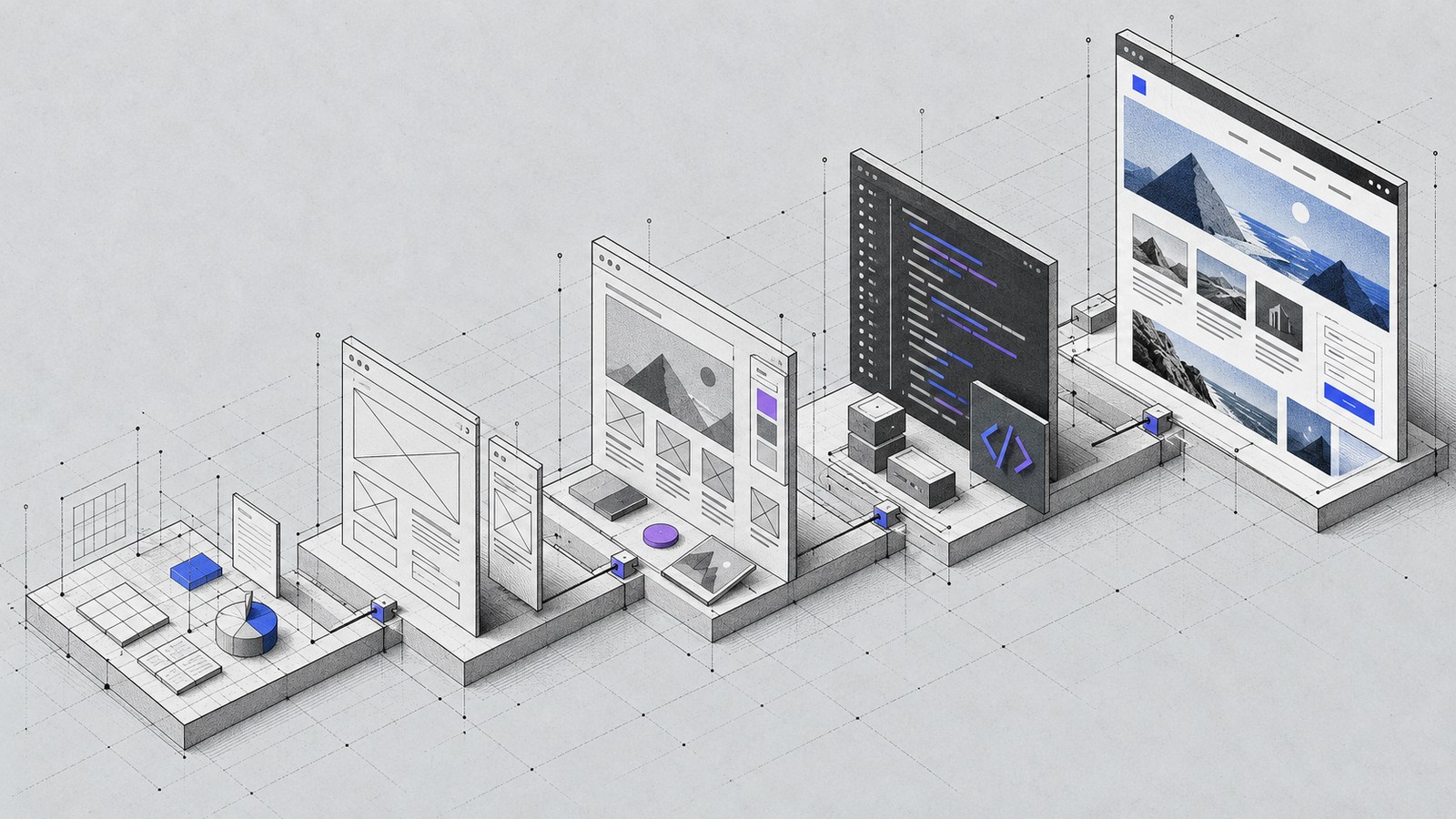
I approach a website as a connected piece of work: the business offer, the customer’s task, the content, the design and the systems behind it. If those parts are planned separately, a polished page can still be confusing or difficult to maintain.
KEYDIV is my independent Web & AI studio. This is how I structure a website project so the decisions remain clear from the first conversation to the handoff.
Start with the problem and the people using the site
The first questions are practical. What does the business offer? Who is the website for? What should a visitor understand or do? What is currently getting in the way?
For a rebuild, I want to know what already works as well as what needs changing. Existing content, search visibility, editing habits and integrations deserve attention before choosing a new technology.
The output is a focused brief: goals, required pages, content responsibilities, important functions and acceptance checks. Scope-based pricing follows those requirements rather than an invented package that fits every project.
Plan the content and page relationships
I map the pages around visitor questions. A service page should explain the service, help someone judge suitability and provide a useful next step. An article should answer its own question and link naturally to related guidance.
I check the available assets and proof at this stage. Templates, concepts and client work need accurate labels. Testimonials and business claims need legitimate sources. Missing evidence is a reason to simplify the presentation, not to make something up.
For an existing site, I also plan the URL migration. The redesign checklist describes the inventory that helps protect useful pages.
Shape a visual direction around the content
The design needs a clear hierarchy, comfortable reading and a recognizable visual system. Typography, space, color and imagery should support what the page is trying to communicate.
I use references to make specific design decisions, then keep those decisions consistent across the website. A reference is useful when it helps explain a layout or interaction; it should not erase the client’s own content and identity.
Motion has a role when it guides attention or makes an interaction clearer. It also needs a readable fallback and reduced-motion behavior. The core information should not depend on an effect completing successfully.
Choose the implementation that fits ownership
Astro is useful for a static-first website with deliberate control over browser JavaScript. WordPress can be appropriate when the editing workflow or required integrations suit it. eCommerce needs its own planning for catalogue, cart, payment and administration.
The Astro versus WordPress guide explains the platform tradeoffs. I want the chosen system to remain usable after handoff, not just be convenient during development.
Forms and automation are part of this scope. I define the trusted submission route, expected fields and delivery behavior. Where a process needs human review, that review should remain explicit.
Build the responsive experience and verify it
I build around reusable components and clear content structure. I keep page-specific behavior focused and avoid adding a large dependency for a small interaction.
Then I check the generated website, not only the code. Important checks include mobile layout, keyboard navigation, headings, links, assets, form validation and failure feedback. Performance tests need recorded conditions, and lab results should not be described as real-traffic outcomes.
SEO checks cover titles, descriptions, production canonicals, structured data, redirects, sitemap and indexing behavior. The SEO launch checklist gives the detail behind that gate.
Launch with a clear handoff
Before publishing, the project needs agreed content, verified account configuration, a tested deployment path and a way to recover from a problem. External changes such as domain routing need a named owner and an explicit launch decision.
The handoff should explain how to edit content, who owns the repository and connected accounts, how forms are delivered and what ongoing maintenance covers. A website should not become a mystery once the initial build is complete.
After launch, the next changes should follow actual observations: customer questions, editing friction, performance data or a new business requirement. That keeps ongoing work purposeful.
Bring a concrete starting point
You do not need a finished brief to begin. An existing website, a page list, a reference or one process that needs improvement is enough for an initial discussion.
Explore KEYDIV services, available templates or more about me. Then share what you want the website to do so the project can start with a clear problem and a useful next step.